How to Handle Oversized Tube Sheet Holes in Boiler Maintenance
You pull the old tubes, put the new tubes in, and go to roll them. Nothing works, and you’re not getting a mechanical joint between the tube and the tube hole. When that happens during a boiler retube, oversized tube sheet holes may be the reason.
What Size Should a Tube Sheet Hole Be?
In new boiler construction, tube holes are typically manufactured 1/32”, or 0.030”, larger than the tubes OD for average boiler tubes around 2”. TEMA charts show varying tube hole sizes depending on the tube OD and also a close fit option for certain applications.
Why Tube Sheet Holes Grow Over Time
Tube holes can grow naturally from heating and cooling but also from retubing the vessel. Every time a tube is expanded into a tube hole it is applying enough pressure to stretch it, and we are counting on the yield strength of the ligaments between the holes to retain that position. All things wear down over time and the more a vessel is retubed the less yield strength it retains.
Starting a boiler up with cold water is one example. You’ll find this in power plants that send power to another state or grid system. Those boilers get shocked a lot, and each shock flexes the tube sheet holes. We’ve seen this on both water tube and fire tube boilers.
How Oversized Tube Sheet Holes Affect the Rolled Joint
As the tube hole gets larger, at some point the assigned tube will run out of structural integrity and will not retain the mechanical joint due to surpassing the rated yield strength. This could also result in tube fracturing by surpassing the rated tensile strength.
Customers often don’t see the problem right away. They take the old tubes out, put new tubes in, and only find out when they go to roll.
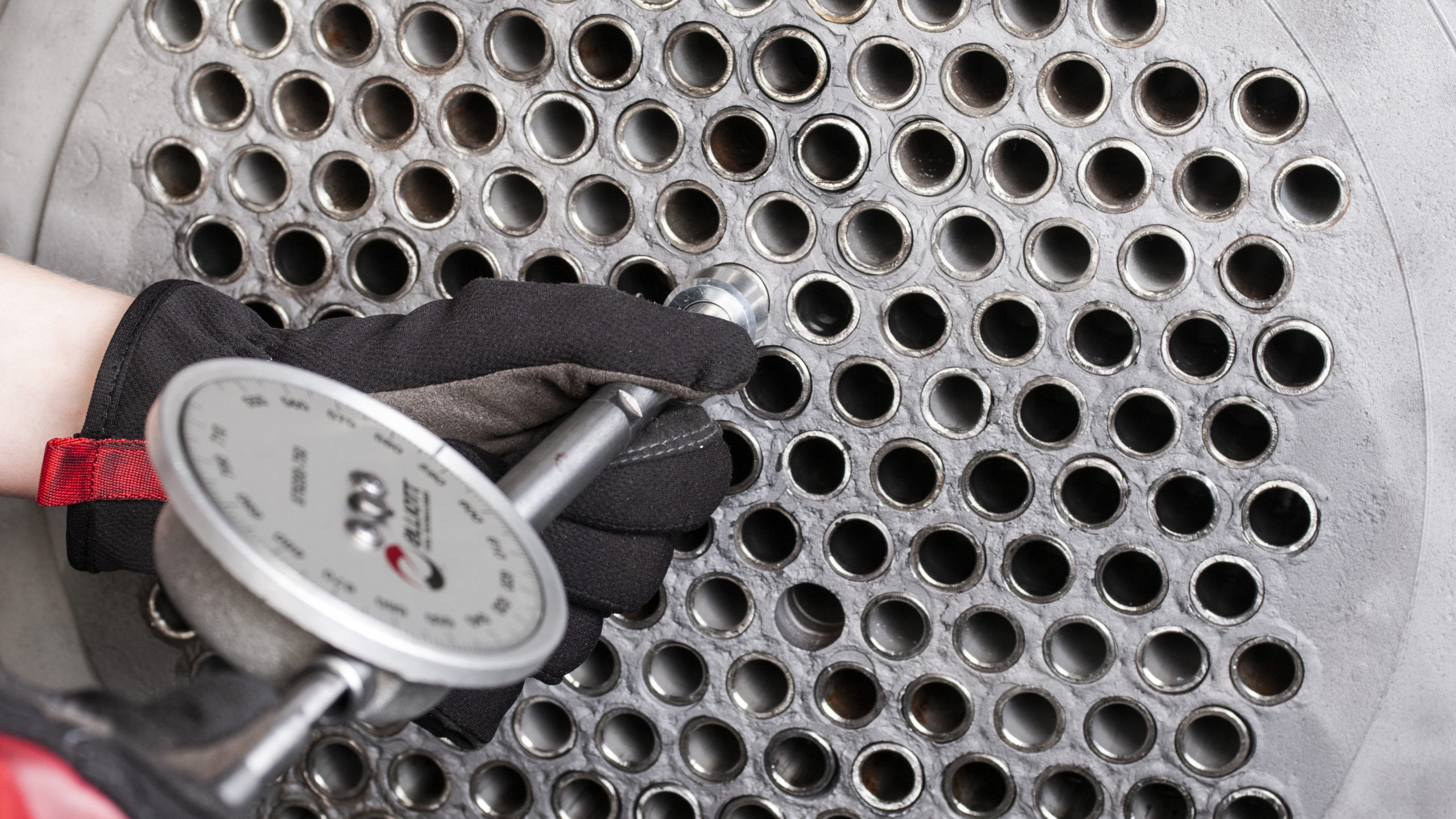
Measure the Hole Before You Roll
Getting a number on the hole will expose the issue quickly. For example, a 2-inch tube with a hole 0.030” over should measure 2.030”. So, what happens if the hole measures 2.075”?
Who Decides How to Handle an Oversized Hole
Before you expand the tube and hope for the best, raise your hand and call for Quality Control (QC) or the Authorized Inspector (AI). How to handle an oversized hole is their call.
How Oversized Tube Sheet Holes Affect the Rolled Joint
As the tube hole gets larger, at some point the assigned tube will run out of structural integrity and will not retain the mechanical joint due to surpassing the rated yield strength. This could also result in tube fracturing by surpassing the rated tensile strength.
Customers often don’t see the problem right away. They take the old tubes out, put new tubes in, and only find out when they go to roll.

Field Responses to Oversized Tube Sheet Holes
In the field, we’ve seen crews handle oversized holes in a few ways. We wouldn’t suggest these, but they do happen:
- Expanding the tube as far as possible, bottoming the tool out, and putting a weld around it
- Sleeving or adding a ferrule to the tube. Sleeving is the more extreme option, and ferrules are more common.
- Plugging and welding the tube, taking it completely offline
Which route to take is up to QC or the Authorized Inspector.
Oversized Tube Sheet Holes Can Be Inconsistent
Oversized holes might not show up across the entire tube sheet. They can be very inconsistent from one hole to the next. Still, if you find one, expect to find more, so take a count of the affected holes.
When new tubes won’t roll the way they should, measure the hole first. If it’s oversized, bring in QC or the Authorized Inspector before you go any further.